WASHINGTON D.C.
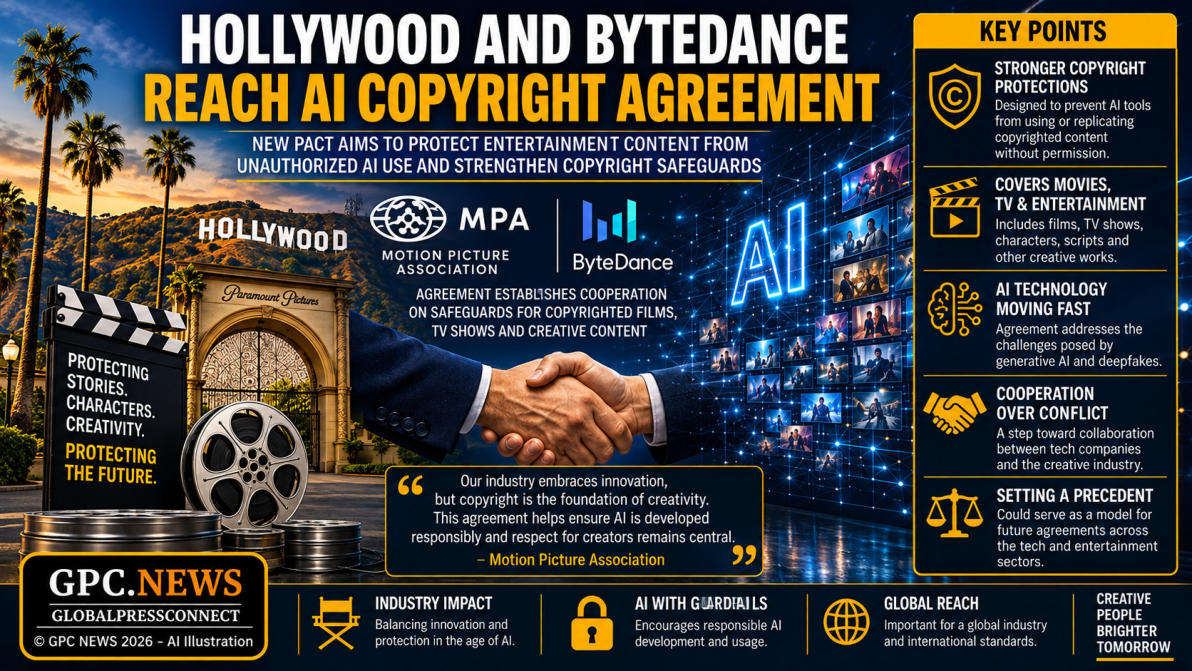
Global Press Connect provides independent news and analysis on international  politics, the economy, and humanitarian developments. © 2026 GlobalPressConnect | GPC.NEWS Founded and operated by Simone Mayer & Helping Hands for Children Foundation Inc. | Los Angeles, California, USA GlobalPressConnect (GPC.NEWS) is an independent international news organization dedicated to delivering accurate, impartial, and timely journalism. Our mission is to provide verified reporting, editorial integrity, and in-depth coverage of global affairs, politics, business, financial markets, technology & AI, entertainment, humanitarian issues, weather, and breaking news. All Rights Reserved. HOLLYWOOD AND BYTEDANCE REACH AI COPYRIGHT AGREEMENT   LOS ANGELES — August 18, 2026 — GPC.NEWS Hollywood and ByteDance have reached a new agreement aimed at protecting copyrighted entertainment content from unauthorized use by artificial intelligence systems, marking another significant step in the rapidly evolving relationship between technology companies and the creative industries.  ByteDance and the Motion Picture Association have agreed to cooperate on safeguards intended to prevent copyrighted films, television programs and other protected material from being improperly reproduced or exploited through generative AI applications. The agreement comes as studios, actors, writers and technology companies confront increasingly difficult questions about how existing intellectual-property protections should apply to artificial intelligence.  AI Creates a New Copyright Battlefield Generative AI systems can now create increasingly sophisticated video, images, voices and other digital content. That technological progress has opened enormous creative possibilities — but it has also created concerns that copyrighted characters, performances, scenes and entire visual styles could be replicated without authorization. Hollywood studios have consequently been pushing technology companies to introduce stronger safeguards. The ByteDance agreement represents an effort to address those concerns through cooperation rather than waiting exclusively for courts or lawmakers to determine the rules.  Protecting Movies and Television For the entertainment industry, the central issue is control. Studios invest billions of dollars creating and marketing films and television productions. Those works contain valuable intellectual property ranging from characters and scripts to recognizable visual elements. Generative AI makes copying or imitating such material dramatically easier. The new framework is intended to strengthen mechanisms that prevent AI tools from generating material that improperly reproduces protected entertainment content.  ByteDance Has Major AI Ambitions ByteDance is best known internationally as the company behind TikTok, but it has also become an increasingly important player in artificial intelligence. Like other major technology companies, ByteDance is developing generative AI systems capable of producing and manipulating digital media. That makes cooperation with Hollywood particularly significant. Video-generation technology is advancing rapidly, and the distinction between professionally produced footage and AI-generated material is becoming increasingly difficult for viewers to recognize.   Hollywood Wants Rules Before Technology Runs Ahead The entertainment industry has already experienced major disputes over AI. Actors have demanded protections against unauthorized digital replicas of their faces and voices, while writers have sought safeguards governing how scripts and other creative work can be used by AI systems. Studios themselves are simultaneously experimenting with artificial intelligence to reduce costs and develop new production tools. Hollywood therefore faces an unusual balancing act: embracing a technology that could transform filmmaking while protecting the intellectual property on which the industry depends.  A Possible Model for Future Agreements The ByteDance-MPA arrangement could provide a template for similar agreements between entertainment companies and AI developers. Rather than attempting to prohibit generative AI, the emerging approach increasingly focuses on establishing boundaries around copyrighted material, licensing and authorized use. That could eventually create a commercial marketplace in which entertainment companies license characters, footage or other intellectual property specifically for AI applications.  Technology Is Moving Faster Than Regulation Governments around the world are still developing laws governing artificial intelligence. Copyright legislation, however, was largely written before generative AI systems existed. Courts are therefore being asked to determine how traditional concepts such as copying, transformation, fair use and licensing should apply to technologies capable of generating new material from enormous amounts of existing content. Private agreements between technology companies and copyright owners may consequently become increasingly important while legislation and court decisions catch up.  GPC.NEWS Analysis: The most significant part of this agreement may be the recognition that AI and copyright cannot realistically be treated as separate worlds. Hollywood is unlikely to stop using artificial intelligence, and technology companies cannot simply ignore ownership of creative material. The emerging solution will probably be a combination of technical safeguards, licensing agreements and new legal standards. If that model succeeds, AI could become not merely a threat to Hollywood intellectual property but an entirely new licensed market for it.
ENTERTAINMENT